
Improving patient and carer support through a targeted audience strategy.
Defining a clear focus, channel strategy and messaging for patient and carer cohorts to create a multi-channel experience that best supports patients and carers navigating pancreatic cancer.
The brief.
PanKind, Australia’s pancreatic cancer foundation, works towards ensuring pancreatic cancer gets the focus it deserves through funding cutting-edge research, driving awareness and advocating for better access to life-saving treatments.
To achieve its mission of tripling survival rates by 2030 and improving quality of life for those affected by pancreatic cancer, PanKind was looking to leverage its digital transformation program to reimagine how it could better reach, connect with and maintain engagement with patients, carers and those at risk of the disease.
In parallel to its strategic rebranding efforts, Gyongyi was engaged to draw on research done to date and work with key stakeholders to define a multi-channel patient and carer experience and audience strategy that supported organisational goals, and to inform both the redevelopment of the website and improvements to CRM data capture and audience segmentation.
The approach.
Taking into account flow on dependencies with digital transformation projects as well as potential implications for marketing positioning, processes and existing programs and services, a deeply collaborative approach was adopted, bringing together all potentially affected areas of the organisation and focusing on guiding key decision-makers through a strategic consideration process of opportunities and risks in line with the core mission of the organisation.
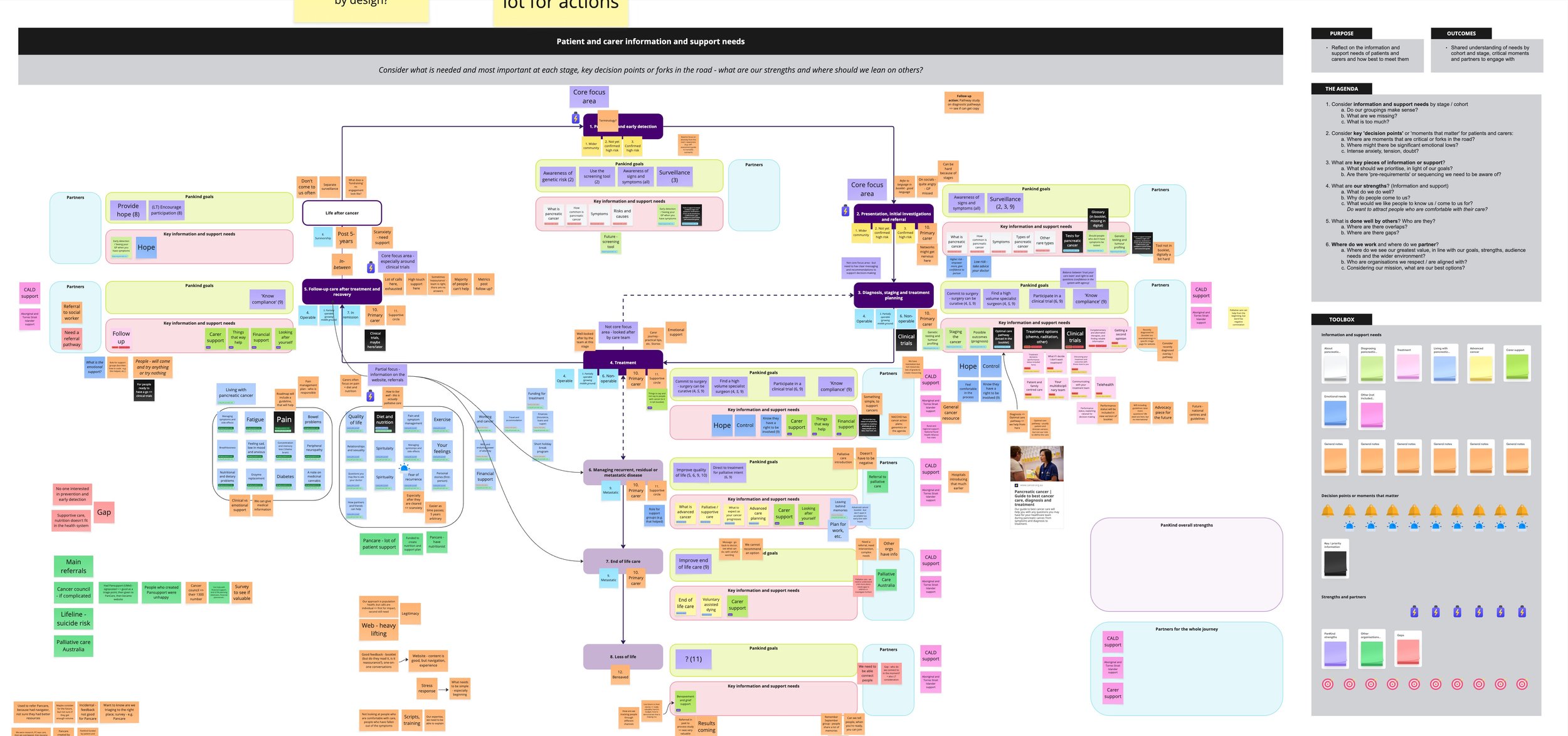
A draft journey map developed during one of the collaborative sessions to capture the non-linear journey of patients and carers affected by pancreatic cancer and the steps and the different needs and goals at each stage.
Guided by service design principles, a process improvement lens as well as a strong focus on balancing duty of care, dignity of risk and privacy principles, we focused on creating shared understanding and alignment around patients and carers, and how identity, goals and needs changed through the cancer journey, requiring tailored approaches that recognised them but did not rigidly categorise them, with flexibility for assessing the support they needed. This formed the basis for defining an experience of how each cohort could be best supported, their supporting journeys and the channels and messaging that best resonated based on an in-depth analysis of significant research done to date, comparative analysis of competitors and peers in Australia and overseas, as well as mapping and co-design workshops. An analysis of the organisation’s strengths, expertise and current and future strategic capabilities together with its mission enabled a clear definition of how each cohort is best reached and engaged with, where partnerships are best leveraged and where internal capability needs to be enhanced.
To support operationalisation and consistency, we focused on developing key documentation that would capture both the overarching strategy, support accountability as well as enable immediate action on the part from key departments. In addition to an audience strategy, this included the development of:
journey and process maps to support the implementation of digital journeys
updated processes to better identify and support patients and carers
documentation of audience cohorts to support segmentation in the CRM
a messaging guide capturing core messages, CTAs and channels for patient and carer cohorts
data points, triage questions and critical must-provide information to support better audience management
a 90-day roadmap to support implementation
an executive presentation to help communicate the change.
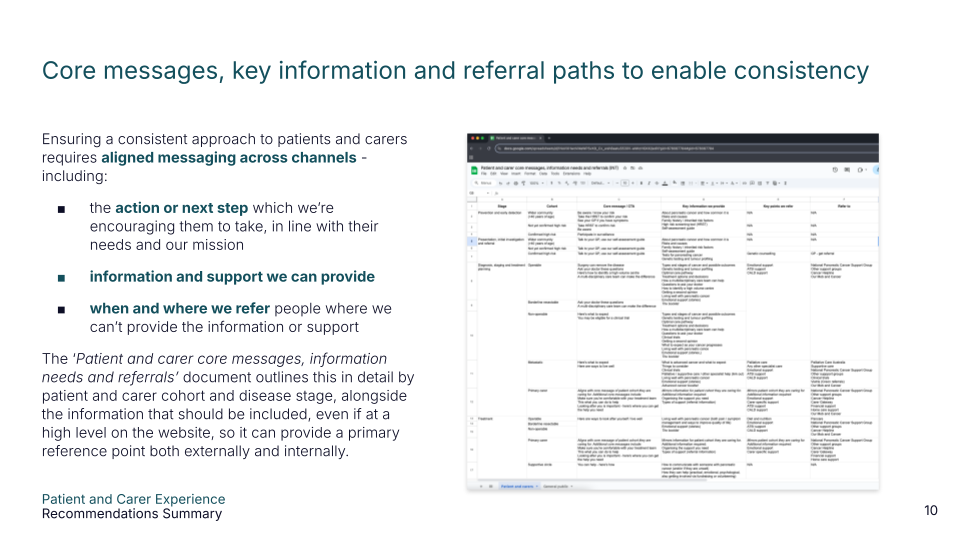
A summary overview of the detailed messaging strategy and call to actions in the executive presentation.
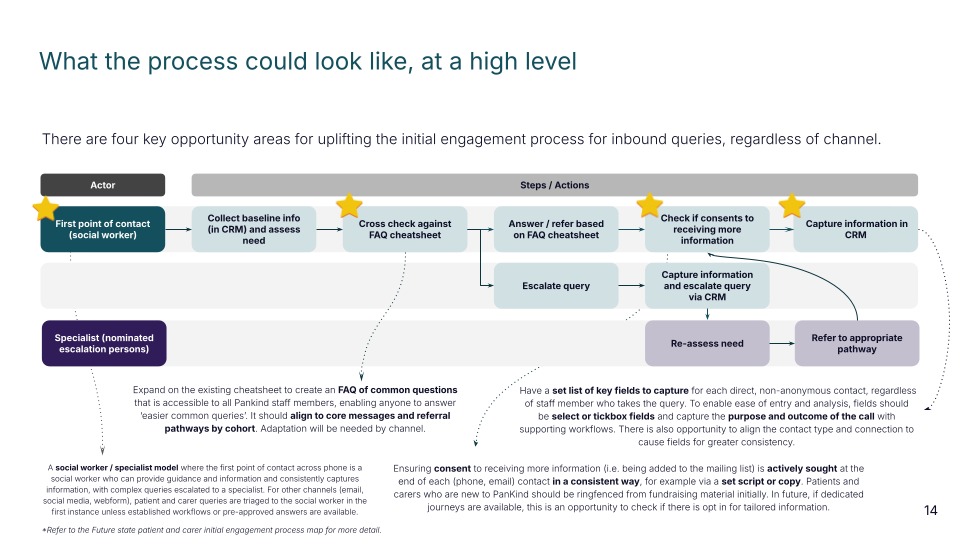
A high level summary of one of the new processes proposed to better support patient and carer identification, triage and support.
Services provided.
Data and existing research analysis
Audience segmentation
Customer journey and process mapping workshops
Future state co-design workshops
Leadership alignment sessions
Development of visual customer journey and process maps and supporting process documentation
Audience strategy and messaging guide
Website information architecture
The outcomes achieved.
The documentation provided a clear blueprint for the organisation to inform its digital transformation programs. The proposed segmentation, messaging and information architecture directly informed the design, navigation and content of the new website developed, which since its launch has received very positive feedback and strong engagement from target audiences. The audience strategy and messaging also informed new marketing campaigns and a new, stronger focus on early screening and awareness, leading to over 7,000 participants in the organisation’s high-risk screening tool on its first day. Supporting email journeys have also been designed for critical cohorts based on recommendations, leading to increased connection and engagement with priority cohorts for prevention and screening.
The processes and capability gaps defined have also led to ongoing transformation of triage, how support is provided and a ‘concierge model’ to ensure patients and carers receive the targeted support they need. The data points also assisted with the CRM review, improving the quality and consistency of data collected, enabling improved engagement and support for patients and carers.
For the organisation, it provided a clear direction and supporting plan to achieve their strategic goals, enabling focus, clarity and alignment.
“The feedback has been great. It’s one of those things that you don’t realise how it will affect your work until it comes to fruition, but now the team are really happy that we’re focusing. I have loved working with Gyongyi and her analytical brain on the patient program piece and look forward to working with her on the next project!”
— CEO, PanKind
Want to learn more? Let’s chat about how we can help you.
No challenge is too big or small. Whether you’re looking for specific advice or a sounding board to explore potential options, we can help.